
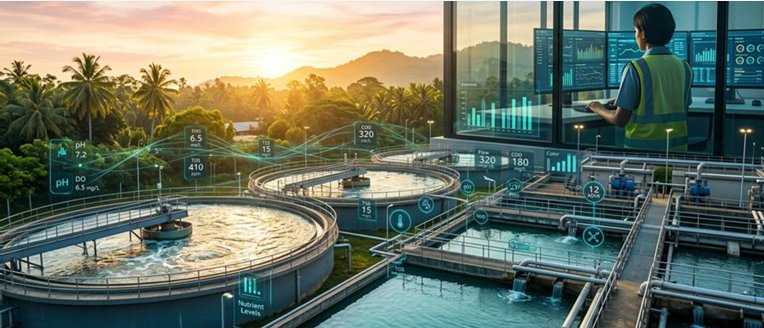
Wastewater carries water, energy and nutrients we can no longer afford to waste. Artificial intelligence is turning treatment plants into recovery hubs and countries like Sri Lanka have a real chance to leapfrog straight to the smartest systems.
From Disposal to Recovery
Every day, our cities and factories send away far more than just water in wastewater. Hidden in municipal and industrial wastewater is a valuable mix of reusable water, recoverable energy and plant nutrients. For most of the last century, we simply treated it, discharged it and forgot about it.
That era is drawing to a close. Affordable sensors, cloud computing, and AI are transforming wastewater treatment plants into water resource recovery facilities, driven by climate pressures, water scarcity, and stricter regulations. AI increasingly serves as the operational intelligence, analysing data, anticipating challenges, and optimizing performance through real-time decisions.
What Makes a Plant “Smart”?
Smart wastewater management uses connected sensors, automated controls and data analytics to run water and wastewater systems in real time instead of relying on fixed schedules, occasional manual sampling and repairs after something breaks.
A conventional plant runs on routine. Operators test water quality periodically, adjust chemical dosing from experience, and fix pumps and pipes once they fail.
A smart plant adds four layers of intelligence:
- IoT sensors that continuously measure flow, dissolved oxygen, turbidity, pH, and contaminant levels.
- SCADA systems (supervisory control and data acquisition) that bring monitoring and control into one place.
- Digital twins: virtual replicas of a plant or pipe network, used to test scenarios safely before applying them.
- Automated control loops that adjust aeration, chemical dosing, and pump speeds without waiting for an operator.
This transition replaces conventional, schedule-based operations with continuous, data-driven decision-making.
Where AI Adds Value
AI enhances treatment plant performance through predictive maintenance, process optimization, digital twins, compliance monitoring, and leak detection. By identifying potential equipment failures early, optimizing aeration and chemical dosing, and enabling engineers to test operational changes virtually, AI improves efficiency while reducing costs and operational risks. It also supports regulatory compliance by detecting process deviations before violations occur and helps minimize water losses through accurate leak detection.
However, AI does not replace sound engineering principles or well-designed treatment processes; rather, it builds upon these foundations to make water and wastewater systems smarter, more efficient, and reliable.
The Global Picture: From Pilots to Scale
AI in water and wastewater has moved beyond scattered pilot projects into genuine scale-up though progress is uneven. Industry estimates put global spending at roughly US$6.2 billion in 2024, rising past US$8.7 billion in 2026.
- North America and Europe lead in maturity. Many industrial utilities use AI-powered digital twins, and municipal utilities are building intelligent networks in response to ageing assets and regulation.
- East Asia has invested at the national level. Japan’s government-backed AI strategy, launched in 2019, spurred funded projects applying AI to water and wastewater operations.
- The Gulf and wider Middle East, facing acute scarcity, use AI to optimize desalination and manage scarce resources; Saudi Arabia has linked AI investment and workforce targets partly to water security.
- Small and mid-sized utilities everywhere, including in parts of Europe, still struggle with the basics: consistent data and in-house expertise.
The last point is particularly significant. AI’s effectiveness depends as much on data quality and institutional readiness as on algorithms, with reliable monitoring being essential.
A Practical Path for Sri Lanka and the Developing World
High costs, limited data and skill gaps remain challenges. A phased, cost-effective approach offers a practical alternative to expensive, centralized systems.
- Start small: leak detection, energy optimization and online monitoring deliver quick returns with modest investment.
- Go modular: decentralized systems suit industrial sites and growing communities and scale with available capital.
- Use the cloud: hosted analytics give access to AI without costly in-house infrastructure.
- Build local capability: reliable instrumentation, trained operators and transparent tools are what turn a pilot into a lasting system.
The Circular Economy Connection
Perhaps AI’s biggest contribution is a change in mindset: it helps us see a treatment plant as a resource recovery facility rather than a disposal site, a cornerstone of the circular economy. The question shifts from “what must we remove?” to “what can we recover?”
- Water reuse: treated effluent redirected to irrigation, industrial cooling or, with advanced treatment, potable reuse, easing pressure on freshwater sources.
- Nutrient recovery: phosphorus and nitrogen extracted from sludge and returned to agriculture as fertilizer inputs instead of polluting waterways.
- Energy recovery: biogas from sludge digestion used to power the plant itself, moving towards energy-neutral or even energy-positive operation.
AI strengthens circular water management by optimizing resource recovery, improving process efficiency, and ensuring consistent water quality. Together, AI and circular design can transform treatment plants from cost centres into resource recovery hubs. Achieving this vision requires reliable data, skilled professionals, and strong partnerships to advance sustainable water management.
Author:

Dr. Tharindu Ritigala,
Director – Business Development, DOSCON Lanka (Pvt) Ltd.
Council Member | Vice Chair (Research & Publications) | Committee Member (Industrial Relations) – IEPSL
Membership No: M0883