
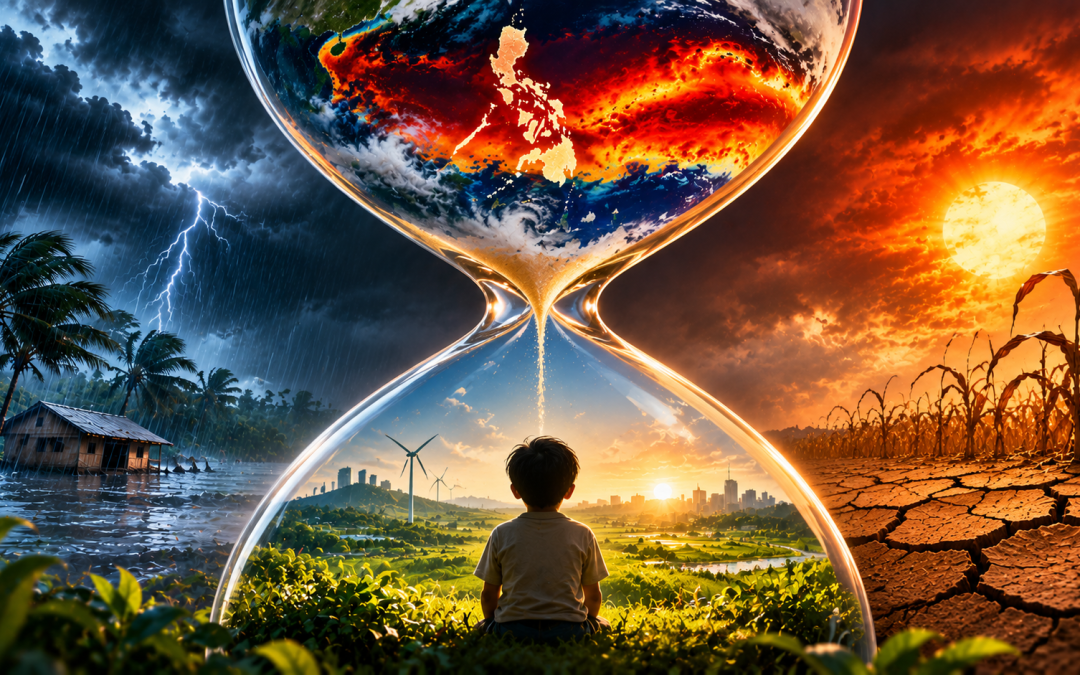
What if we could glimpse the climate of the future without waiting until 2050 or 2100? We cannot travel forward in time, but nature occasionally creates conditions that allow us to see how our communities, farms, cities, and ecosystems respond when the climate deviates from what we believe is normal. One such natural experiment is El Niño.
El Niño begins with unusually warm surface waters in the tropical Pacific Ocean. Although this occurs thousands of kilometres away from Sri Lanka, changes in the ocean interact with the atmosphere, influencing temperature, winds and rainfall across many parts of the world. No scientist created these conditions, and no laboratory could reproduce them on such a scale. Nature has created the experiment for us. The question is whether we are prepared to learn from it.
Most discussions surrounding El Niño understandably ask what it will do to us.
Will temperatures rise? Will rainfall change? What will happen to agriculture, water resources or food security? These questions matter. But perhaps we should ask another: What can the coming El Niño teach us about living in a changing climate?
This does not mean an El Niño represents the climate of 2050 or 2100. El Niño and climate change are different phenomena. El Niño is a naturally occurring, temporary fluctuation of the ocean-atmosphere system, while human-induced climate change is altering our long-term climatic conditions. Nevertheless, El Niño can temporarily place environmental and human systems under unusual climatic stress. It can reveal how prepared we are when familiar conditions are disrupted.
Our society is built around expectations of what is “normal”. Farmers cultivate according to seasons. Reservoirs are managed based on expected rainfall. Urban drainage systems are designed using historical rainfall patterns. Buildings are constructed for particular climatic conditions. But as the climate changes, yesterday’s definition of normal may become an increasingly unreliable guide to tomorrow.
This is where El Niño becomes more than a weather story.
Which crops tolerate unusual conditions and which fail? Which communities manage water effectively during shortages? Which neighbourhoods repeatedly flood under intense rainfall? How do fisheries, forests and coral reefs respond to environmental stress? Most importantly, who adapts, who struggles, and why?
After extreme events, we are very good at counting damage: flooded houses, damaged crops, depleted reservoirs and economic losses. But we should become equally interested in measuring resilience. If one farming community copes better than another, what did it do differently? If one ecosystem recovers while another deteriorates, why? If a particular water-management practice succeeds, can it be adopted elsewhere? Solutions to future climate challenges may already exist within our communities; we simply need to recognise and learn from them.
When El Niño eventually fades, returning immediately to “business as usual” would therefore be a missed opportunity. Weak drainage exposed to extreme rainfall can be redesigned. Agricultural practices that perform poorly under climatic stress can be reconsidered. Cities struggling with heat can be adapted. Vulnerable ecosystems can receive greater protection, while successful early-warning systems can be strengthened. A temporary climatic disturbance can provide permanent lessons, if we pay attention.
The increasingly frequent and intense climate-related challenges, including the disruptive effects of El Niño on rainfall patterns, temperatures, and water availability, bring us to the broader question of sustainability. Sustainable development is commonly understood as meeting the needs of the present without compromising the ability of future generations to meet their own needs. But those “future generations” are not abstract people living in some distant century. A child born today will step into early adulthood around 2050, potentially witnessing the arrival of 2100.
What kind of Sri Lanka is that generation going to inherit? Will the homes and urban areas we currently inhabit be livable? Can our agricultural sector and water networks withstand intense climatic instability? Even our natural resources: from marine life to inland forests – face severe risk if our infrastructure relies entirely on outdated climate data. Ultimately, sustainability requires making strategic decisions today that remain viable under tomorrow’s harsher realities. While the upcoming El Niño is not a carbon copy of what 2050 will look like, it serves as a critical diagnostic tool. It reveals the hidden vulnerabilities that stable years cover up, highlighting which systems fail and which adapt. Most importantly, it delivers these insights while we still have a window of opportunity to intervene.
So instead of asking only, “What will El Niño do to us?”, perhaps we should ask,
“What can the coming El Niño teach us about how to live in a changing climate?”
The article was originally published in the IEPSL Newsletter Volume 03 Issue 03 of 2026 (ISSN 3021-6133).
Visit: https://www.iepsl.lk/wp-content/uploads/2026/11/IEPSL-Newsletter-2026-September-Vol-3-Issue-3.pdf
Author:

Dr. Erangi Imasha
Senior Lecturer, Curtin University of Colombo
Membership No.: M00628