
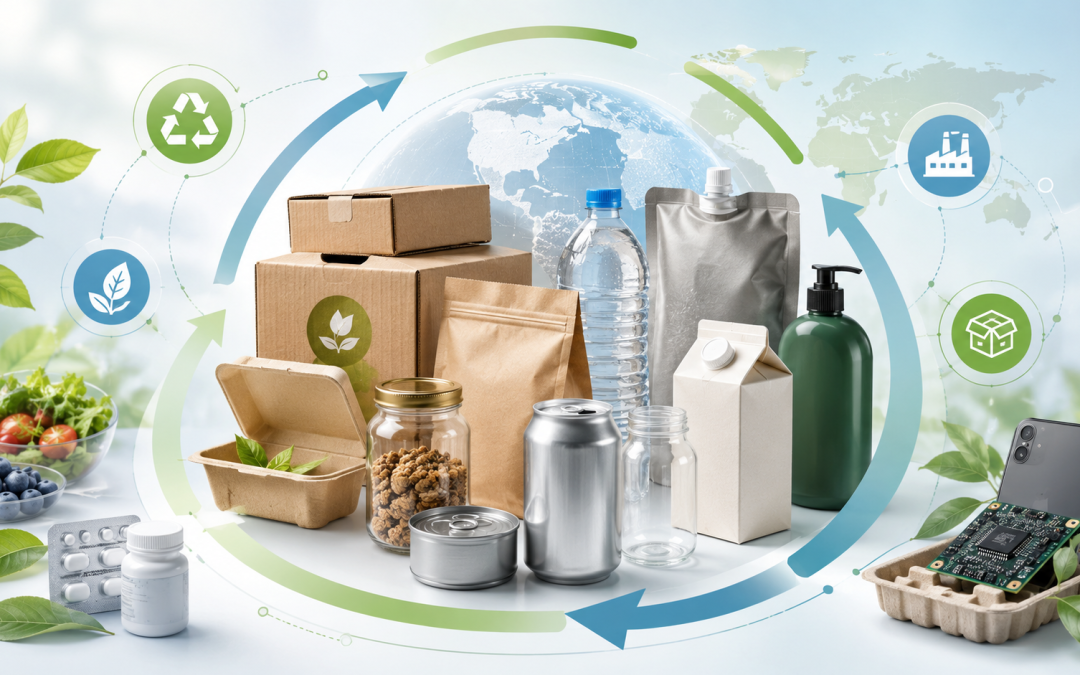
“Packaging is indispensable to product safety, preservation, branding, and transport. However, the linear model of “take-make-dispose” has rendered much of the global packaging stream unsustainable, with massive resource loss and post-consumer waste accumulation. Based on the most recent data available, packaging continues to be the largest application of plastics globally. According to Plastics Europe’s “Plastics – the Facts 2023” report, packaging accounted for approximately 40% of total plastic demand in 2022. This significant share underscores the critical role of packaging in the broader context of plastic production and waste management. The high consumption rate of plastics in packaging highlights the importance of implementing sustainable practices, such as the principles of the circular economy, the 3Rs, and EPR, to mitigate environmental impacts and promote resource efficiency. By focusing on these strategies, industries can work towards reducing the environmental footprint of packaging, enhancing recyclability, and fostering a more sustainable approach to plastic use.”
The packaging industry plays a vital role in protecting products and enabling global commerce, yet it remains a major contributor to resource depletion and environmental pollution. Implementing circular economy principles, the 3Rs (Reduce, Reuse, Recycle), and Extended Producer Responsibility (EPR) provides a transformative approach to addressing these challenges. This article explores how these frameworks can be applied across sectors to reduce waste, enhance material efficiency, and drive sustainable innovation while reinforcing the critical role of packaging in product quality preservation.
Packaging is indispensable to product safety, preservation, branding, and transport. However, the linear model of “take-make-dispose” has rendered much of the global packaging stream unsustainable, with massive resource loss and post-consumer waste accumulation. Based on the most recent data available, packaging continues to be the largest application of plastics globally. According to Plastics Europe’s “Plastics – the Facts 2023” report, packaging accounted for approximately 40% of total plastic demand in 2022. This significant share underscores the critical role of packaging in the broader context of plastic production and waste management. The high consumption rate of plastics in packaging highlights the importance of implementing sustainable practices, such as the principles of the circular economy, the 3Rs, and EPR, to mitigate environmental impacts and promote resource efficiency. By focusing on these strategies, industries can work towards reducing the environmental footprint of packaging, enhancing recyclability, and fostering a more sustainable approach to plastic use.
A circular economy aims to eliminate waste and pollution by keeping products and materials in continuous use and regenerating natural systems. In the packaging sector, this involves designing products for durability, modularity, disassembly, and recyclability. Such strategies enable companies to move beyond mere compliance, fostering regenerative business models. Brands adopting circular packaging not only reduce their environmental footprint but also unlock new value through recovered resources, reverse logistics, and closed-loop material cycles. The Ellen MacArthur Foundation emphasizes that transitioning to a circular economy for plastics could reduce the annual volume of plastics entering our oceans by 80%, cut greenhouse gas emissions by 25%, and generate savings of USD 200 billion per year by 2040. To achieve this, the foundation outlines three key actions: eliminate problematic and unnecessary plastic items, innovate to ensure that the plastics we do need are reusable, recyclable, or compostable, and circulate all the plastic items we use to keep them in the economy and out of the environment. Recent studies highlight the importance of integrating design for disassembly (DfD) into packaging, facilitating easier recycling and material recovery. This approach not only enhances recyclability but also supports the development of modular packaging solutions that can be efficiently repaired, refurbished, or repurposed. By embedding such principles into packaging design, companies can significantly contribute to a more sustainable and circular economy.
The 3Rs form the practical foundation of circular design and material stewardship. Reduce focuses on optimizing packaging dimensions and materials to minimize input use and waste output without compromising product protection. Reuse involves designing reusable packaging systems for intra-logistics, retail, and refill models. Recycle emphasizes enabling easy separation, clean recovery, and reprocessing of materials by standardizing components and labeling. Material purity, particularly in mono-material packaging, is essential for effective post- consumer recycling (Nefab, 2022). These principles help manufacturers move from high- volume, disposable designs to high-value, sustainable packaging systems.
EPR is a policy mechanism that requires producers to take financial and/or operational responsibility for the end-of-life management of their packaging. It is a key enabler of circular economy practices, shifting the burden from municipalities to the businesses that place packaging on the market. EPR encourages investment in sustainable materials, innovation in eco-design, and support for national recycling infrastructure. Countries like Germany, Canada, and India have introduced EPR schemes to accelerate waste recovery and improve circular performance.
Beyond sustainability, packaging is essential for preserving product quality, safety, and usability across sectors.
In the food industry, improper packaging leads to spoilage, microbial contamination, and nutritional loss. Inadequate packaging contributes significantly to spoilage and loss across the food supply chain. Up to 40% of global food production is wasted, often due to poor post- harvest handling and packaging (Food and Agriculture Organization [FAO], 2023).
PET bottles and Tetra Pak cartons effectively preserve beverage quality by maintaining carbonation, taste, and extending shelf life. However, environmental concerns arise due to their material composition and recycling challenges. Tetra Pak cartons, while lightweight and having a lower carbon footprint compared to glass and PET bottles, are often not recycled due to their composite materials, leading to landfill accumulation. Similarly, PET bottles, despite being recyclable, have low global recycling rates, contributing to plastic pollution. These issues underscore the need for sustainable beverage packaging solutions that balance product preservation with environmental responsibility. In the pharmaceutical sector, packaging protects from light, moisture, and air; critical to maintain drug efficacy and safety. In electronics, antistatic and moisture-proof packaging safeguards sensitive components from corrosion and damage. Thus, packaging is not a secondary concern but a critical component of quality assurance, affecting consumer trust, product efficacy, and health outcomes.
Adopting circular and EPR-aligned strategies offers wide-reaching benefits. Environmentally, they reduce material extraction, greenhouse gas emissions, and landfill dependency. Economically, they lower raw material and disposal costs while increasing resource efficiency. From a regulatory standpoint, they improve compliance with emerging policies and plastic reduction mandates. Reputationally, they enhance brand equity through visible sustainability commitments. Leading brands and governments are integrating circular design principles not just to reduce impact, but to build resilient, future-proof supply chains.
The convergence of the circular economy, 3R principles, and EPR frameworks provides a powerful pathway to overhaul the sustainability of packaging systems globally. As regulatory and consumer pressures mount, industry leaders must reimagine packaging not just as a container but as a strategic asset for sustainability, quality assurance, and brand differentiation. Real change will require cross-sector collaboration, robust infrastructure, and policy support to mainstream circular packaging and shift global markets toward regenerative design.
The article was originally published in the “Daily Mirror” on 05th of June 2025.
Author:

Ajith U.K. Ethugala
Senior Vice President (IEPSL),
Fellow and Chartered Environmental Professional