
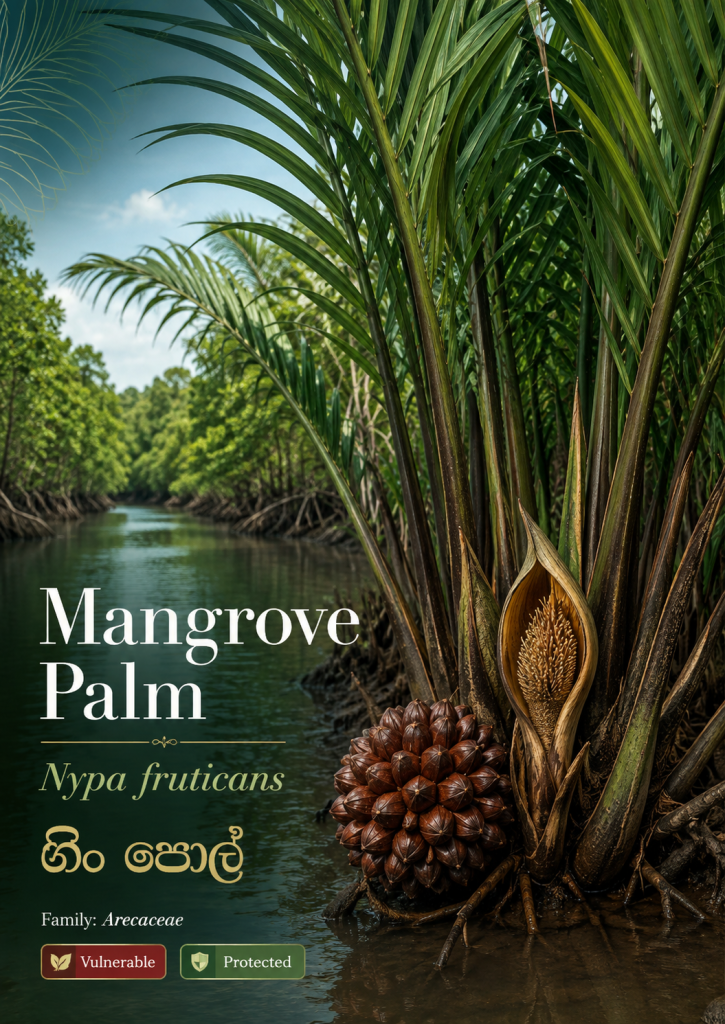
Nypa Palm (Nypa fruticans)
The Nypa palm (Nypa fruticans) belongs to the family Arecaceae and is the only palm species adapted to mangrove-associated ecosystems. It is the sole member of the genus Nypa (monotypic) and is considered a “living fossil” among the oldest angiosperms.
This species plays an important ecological role in mangrove ecosystems and has been classified as VU (Vulnerable) according to the 2020 National Red Data List.
Distribution
In Sri Lanka, the Nypa palm is mainly found along the southwestern and western coastal belts. Its distribution extends from Tangalle (Kahandamodara, Ranna, Hungama) through Lunama, Dikwella, the banks of the Nilwala River, Mirissa, Weligama, Ahangama, Madolduwa, Habaraduwa, the Gin River, Rathgama, Telwatta, Madu Ganga, Bentara Ganga, Kalu Ganga, Bolgoda Ganga, and further north to Chilaw and Puttalam.
Beyond Sri Lanka, it occurs in tropical and subtropical regions of the Indo–West Pacific, including India, Indonesia, and Australia.
Ecological Importance
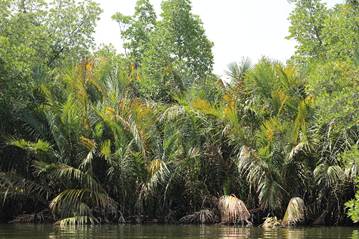
The Nypa palm grows in coastal and estuarine habitats and plays key ecological roles such as:
- Reducing coastal erosion
- Protecting inland areas
Morphological Features
Only the leaves, flowers, and fruits are visible above water. The stem grows horizontally beneath the muddy substrate in the form of a rhizome and can extend several meters.
Vegetative propagation occurs through the growth of shoots from this rhizome, which is a distinctive feature of the species.
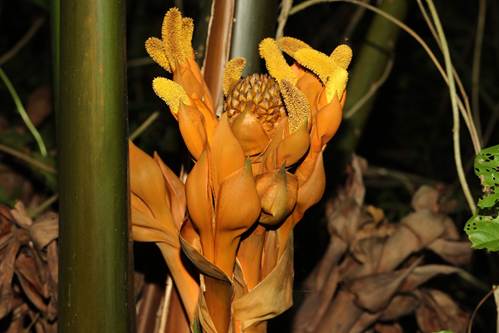
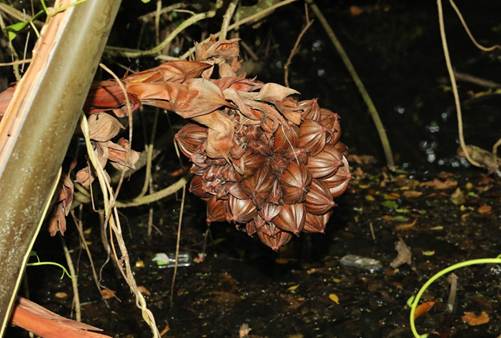
The inflorescence is large and unique with,
- Female flowers (globose cluster) at the top
- Male flowers (spike-like cluster) below
These can be clearly distinguished.
Traditional Uses
Since ancient times, the Nypa palm has been widely used by humans for various purposes:
- Sap (toddy) extracted from the inflorescence is used to produce treacle, jaggery, and alcoholic beverages
- Leaves are used to make hats, bags, baskets, mats, boxes, and thatching materials
Notably, in the Balapitiya and Ambalangoda areas, the trunk of the Nypa palm was traditionally used as a primary raw material in puppet and mask-making industries.
Conservation Status
At present, the Nypa palm is threatened due to habitat destruction and environmental changes. Therefore, it has been legally protected under Sri Lanka’s Fauna and Flora Protection Ordinance (FFPO).
Author and Photograph Credentials:

Dr. Nilanthi Rajapakse (Member: Research and Publications Committee)
Department of Wildlife Conservation