
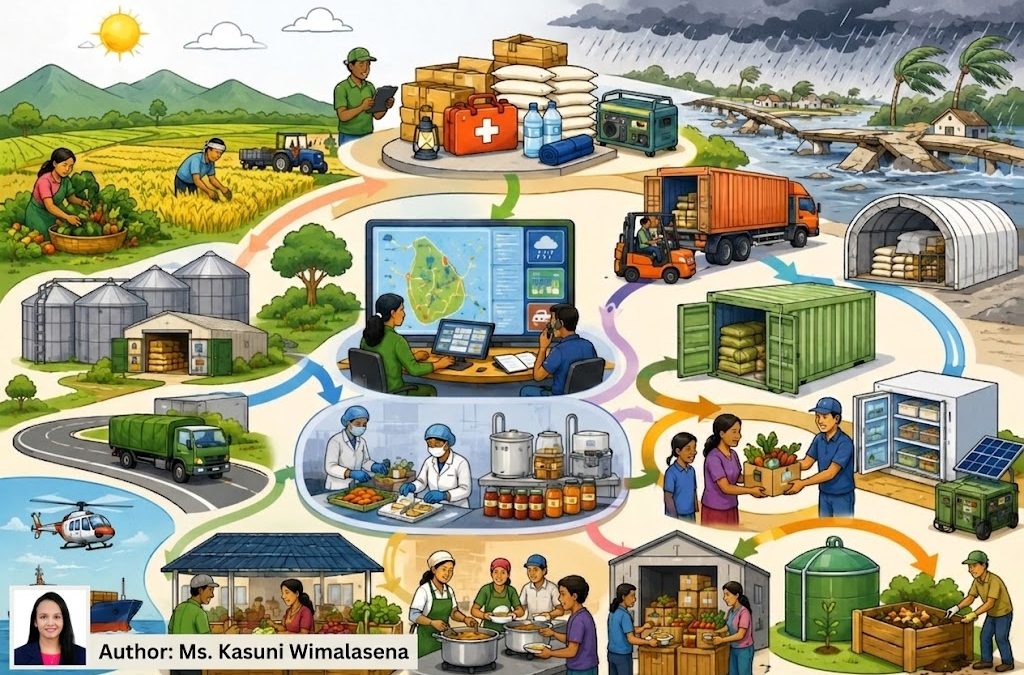
Sri Lanka is considered to be highly susceptible to adverse climate effects due to its unique geographical position and socio-economic conditions. Over the years, Sri Lanka has faced a range of climate hazards, including floods, droughts, cyclones, etc. The country’s agricultural activities are directly affected by this variability and extreme events, leading to potential food insecurity. These disruptions not only decrease production at the farm level but also break and interrupt the entire supply chain, making it harder to move food safely and efficiently to the consumption stage. Hence, it is important to look at the midstream stages and their strategic controls in the event of a climate-induced disaster, in order to ensure food availability, reduce post-harvest losses, and stabilize market supply. Under the midstream stages, we can focus on the storage, transport, coordination, processing, and redistribution levels of a food supply chain. There should be emergency measures as well as mid- and long-term preparedness for food security under adverse conditions.
When a disaster warning is issued, it is important to have prepositioned buffer stocks of ready-to-use food, medical kits, shelter gear, and logistics equipment closer to the disasterprone areas so that they can be released immediately when supply lines break. It is equally important to deploy mobile storage units and temporary warehouses to protect grains and packaged foods from pests and exposure, given that the fixed warehouses may get damaged.
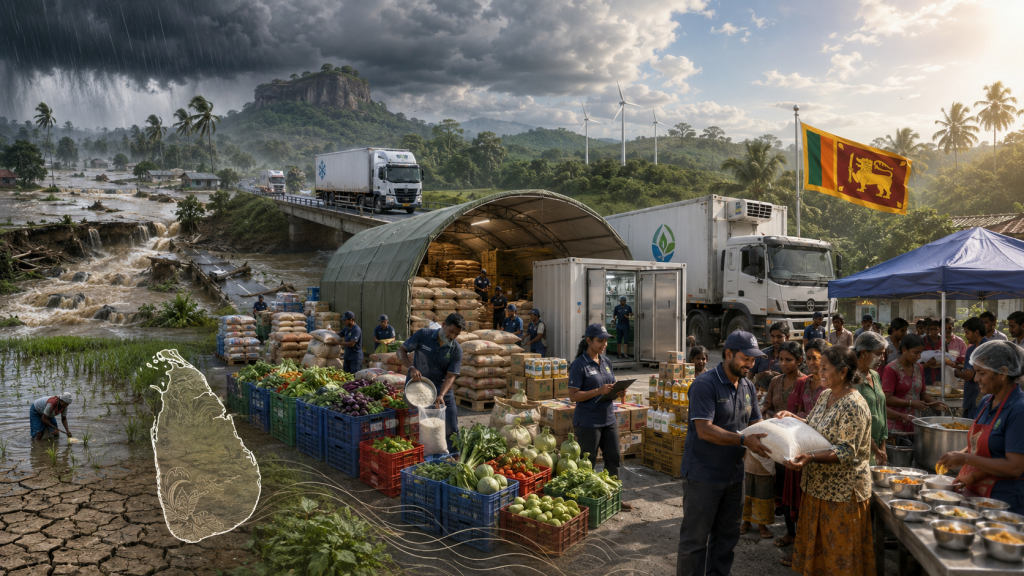
As seen in recent past events, especially with Cyclone Ditwah, roads and common access routes failed, making it difficult to provide necessities to the affected population. The flooding damaged roads, bridges, irrigation systems, crops, and household food stocks at the same time, illustrating that climate disasters interrupt both supply and logistics.
There should be systems identified to carry the goods through safe passages and corridors. Emergencies overwhelm local systems, so the responsible agencies should centralise route information, warehousing, access updates, last-mile infrastructure, and transport services. The necessary directions, leadership, coordination, information management, and common logistics services should be provided when local capacity is exceeded. Modern emergency food supply chains increasingly rely on live planning tools to identify bottlenecks, reroute shipments, and reduce food loss. Digital platforms help it plan in real time, identify and manage risks, and deliver more efficiently.
When fresh food cannot move quickly enough, it is crucial to convert it into more stable forms or produce semi-processed foods. According to the FAO, food processing increases food availability beyond the area and season of production, while the World Food Programme also increasingly distributes fortified staples such as wheat flour, maize meal, and rice in emergency programmes. For Sri Lanka, this means that midstream control during climate disasters must include edible-food redistribution, diversion of damaged-butsafe food to processing where possible, and rapid conversion of unavoidable waste into compost or biogas instead of allowing it to accumulate as a public-health and environmental burden. Stronger distribution systems, climate-resilient cold storage, preservation research, rapid conversion of perishables into processed and semi-processed foods, and organized food banks can together reduce losses, protect nutrition, stabilise markets, and make the food supply chain more shock-resistant. In that sense, midstream control is not a secondary issue in disaster management; it is one of the main conditions for national food security.
Simultaneously, for perishable and damageable goods, it is advisable to use reefer containers, cold storage facilities, and generators if possible. Simple midstream fixes such as reusable plastic crates, better stacking, cleaner handling, and safer loading can save large amounts of fresh food. Food banks, community kitchen and, shelters and intermediary organisations are established approaches that can collect the edible surplus, store and process if needed, and redirect those to the people in need. At the same time, it is vital to ensure hygiene, contamination control, and proper waste management so that unsafe food is separated and not redistributed.
When it comes to the mid- and long-term strategies, Sri Lanka should focus on climate disaster preparedness that extends control much more than just moving food from one point to another. A resilient system is required that can keep food safe, available, and affordable even when the normal market flows are disrupted. One of the weaknesses observed in Sri Lanka’s midstream controls is not only the loss of food at production sites but the failure to move it quickly and safely through collection points, wholesale markets, transport corridors, and retail channels.
Another major response could be to scale up research-based food preservation and food processing, also focusing more on “process before spoilage” for emergency preparedness. This is important as preservation doesn’t just merely cut down on waste, but also buys time, stabilizes prices, protects farmers’ revenue, and creates stocks that can be later used. Research is needed to ensure that perishable foods are preserved not merely as sauces, purees, or other processed by-products, but also as nutritious, convenient main food. Since rice is the staple food in Sri Lanka and the country’s food culture is built around rice-based meals, food preservation strategies should be developed in ways that fit local meal patterns and consumer preferences. This would make preserved foods more practical, acceptable, and useful during both normal times and emergencies.
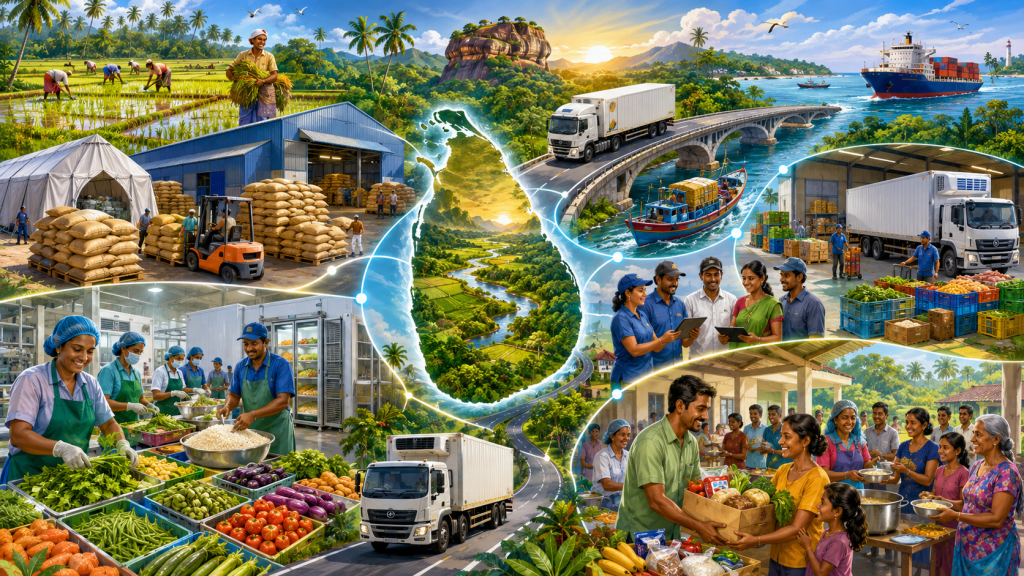
Overall, Sri Lanka’s response to climate-related food-supply disruption should move from a narrow focus on production to a broader focus on midstream resilience.
The article was originally published in the IEPSL Newsletter, Vol 03, Issue 01 (ISSN: 3021-6133) in March 2026. the
Author:

Kasuni Wimalasena | (M01167)
Researcher, Global Edulink, United Kingdom.
Secretary – Research & Publications Committee IEPSL (2025/27).