
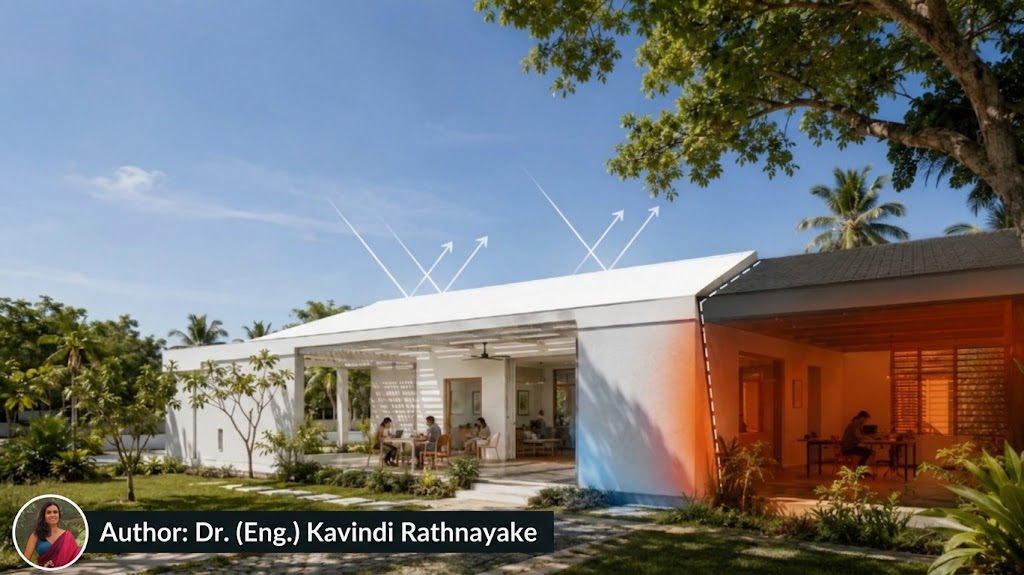
The next climate battle may begin not under the open sky, but beneath our own roofs. As heatwaves become more frequent and intense due to climate change and El Niño events, Sri Lanka must rethink what constitutes a “comfortable building”. Before the first fan starts spinning and the first AC is turned on, the built environment has already chosen whether to invite the heat in or keep it out. A home, school, hospital, or workspace should not only shelter from the rain; it must protect people from harmful indoor temperatures and reduce reliance on expensive air conditioning even during periods of power stress. The most effective response is not to wait until buildings overheat and then cool them mechanically. It is to design and upgrade them so that less heat enters in the first place. This can be guaranteed through passive cooling: practical, low-energy measures such as cool paints, reflective roofs, shading, natural ventilation, insulation and climate-responsive design.
Heat is a building problem.
During a heatwave, roofs, walls, paved surroundings and unshaded windows absorb solar radiation for hours. Dark concrete and metal roofs can become especially hot, transferring heat into rooms below long after the outdoor temperature has begun to fall. This is more than an inconvenience. Excess indoor heat affects sleep, concentration, productivity and health. It is particularly serious for older people, infants, patients, outdoor and factory workers, and children in crowded classrooms. When many households and businesses turn on air conditioners simultaneously, electricity demand rises sharply, increasing operating costs and placing added pressure on the power system.
Buildings designed for passive cooling reduce this exposure. The IPCC identifies measures including solar shading, insulation, natural ventilation and high-albedo or highly reflective materials on roofs and walls as ways to adapt buildings to extreme heat. It concludes that combining shading, insulation and effective natural ventilation is among the most promising approaches.
Keep solar heat outside.
The first principle of heat-resilient design is simple: prevent sunlight from becoming trapped inside the building. A well-designed building considers orientation, roof form, window size and air circulation. Long walls and large windows exposed to scorching sun should be shaded. Roof overhangs, verandas, vertical fins, external blinds, trees and louvres can intercept sunlight before it strikes glass and walls. Natural ventilation is equally important. Openings placed to capture prevailing breezes, high-level vents that allow hot air to escape, ventilated roof spaces and operable windows can help remove accumulated heat. At night, when outdoor conditions permit, ventilation can flush out heat stored in walls, ceilings and floors during the day.
These strategies are not new to Sri Lanka. Deep eaves, shaded courtyards, verandas and cross-ventilation have long been features of climate-sensitive tropical architecture. The challenge is to adapt those principles to modern houses, apartments, schools, warehouses and commercial buildings rather than sealing every space behind heat-absorbing glass and mechanically cooled interiors.
Why cool roofs matter during El Niño events.
During El Niño events, Sri Lanka may experience prolonged warmer and drier conditions, increasing heat exposure in buildings. Since roofs receive the highest direct solar exposure, cool roof coatings provide an accessible passive-cooling solution. Their high solar reflectance and thermal emittance help reflect sunlight, release absorbed heat, reduce roof temperatures, and limit heat transfer indoors.
This can improve comfort, particularly on top floors and beneath metal or exposed concrete roofs. According to the United States Environmental Protection Agency, cool roofs may reduce maximum indoor temperatures in non-air-conditioned homes by approximately 1.2-3.3°C and lower peak cooling demand in air-conditioned residences by 11-27%.
Cool roofing materials may also remain about 28-33°C cooler than conventional materials during peak summer conditions, although the actual difference depends on the roof colour, solar reflectance, weather, construction and maintenance. During El Niño events, reducing roof heat gain can significantly improve thermal comfort in built environments before mechanical cooling is used. In air-conditioned buildings, cool paints can reduce cooling demand, electricity consumption and related greenhouse gas emissions.
However, cool paint alone cannot overcome poor ventilation, unshaded windows, inadequate insulation, or internal heat sources. Effective heat resilience requires an integrated approach combining reflective coatings with roof insulation, external shading, cross-ventilation, reduced west-facing glazing, trees and landscaping, and energy-efficient fans or air conditioning. Research shows that these strategies can reduce heatwave impacts, although their effectiveness depends on local climate conditions and building design.
Build for tomorrow’s heat
Sri Lanka’s next generation of buildings should be designed to work with the climate, not fight it entirely through air conditioning. Every new roof, renovation, and public-building project is an opportunity to reflect more sunlight, create shade, admit breezes, while reducing avoidable heat gain. Homeowners should ask for cool-roof options when repainting. Businesses should assess roof heat, shading and ventilation as part of their energy strategy. Developers should make passive cooling a standard design requirement. Public authorities should lead by upgrading schools, hospitals and community buildings where heat protection matters most. The question is no longer whether passive cooling is desirable. As hotter days become a defining reality, a new era of smarter buildings to beat the heat is essential for comfort, affordability, public health and long-term resilience.
Author :

Dr. (Eng.) Kavindi Rathnayake
Research and Development Lead, Nippon Paint Lanka (Pvt) Ltd.
Committee Member, Industrial Relations Committee – IEPSL (Membership No.: M01183)
The author is a civil engineer, researcher and sustainability professional with a PhD in Civil Engineering from the University of Moratuwa. Her career spans academia, scientific research and industry, with a strong focus on translating research into practical and sustainable solutions.
She currently contributes to sustainability and innovation at Nippon Paint Lanka, working across green-building solutions, cool-paint technology, climate-responsive products, renewable energy and sustainability initiatives. Alongside her industry role, she serves as a visiting lecturer, consultant and auditor in sustainability and green building solutions. She is also a Committee Member of the Industrial Relations Committee of the Institute of Environmental Professionals Sri Lanka (IEPSL), contributing to professional and industry engagement.
The article was published in the Daily Mirror on 28th of August.
Visit the article: https://www.dailymirror.lk/news-features/El-Ni%C3%B1os-Warning-A-Call-for-Smarter-Buildings-to-Beat-the-Heat/131-348981