
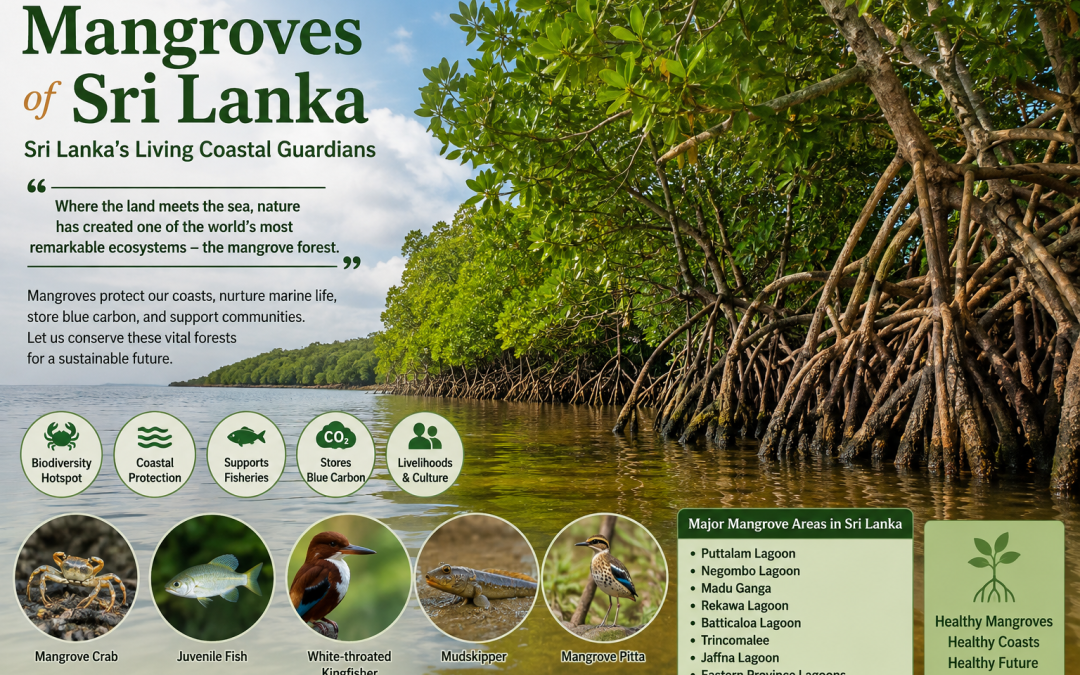
“Where the land meets the sea, nature has created one of the world’s most remarkable ecosystems – the mangrove forest.”
Sri Lanka, an island nation blessed with an extensive coastline, is home to a diverse range of coastal ecosystems. Among them, mangrove forests are among the most valuable yet least appreciated natural treasures. Although they occupy only a small area of the country’s coastline, mangroves play an enormous role in protecting biodiversity, supporting fisheries, mitigating climate change, and safeguarding coastal communities.
Mangroves are a unique group of trees and shrubs specially adapted to survive in saline, waterlogged, and oxygen-poor soils along estuaries, lagoons, river mouths, and sheltered coastal areas. Their remarkable root systems enable them to withstand tidal fluctuations while stabilizing shorelines against erosion.
Sri Lanka is home to 21 true mangrove species and more than 30 mangrove-associated plant species, making it one of the richest mangrove floras in the Indian Ocean region. These forests are found along almost the entire coastline, particularly in areas such as Puttalam Lagoon, Negombo Lagoon, Madu Ganga, Rekawa Lagoon, Batticaloa Lagoon, Trincomalee, Jaffna Lagoon, and the Eastern Province lagoons.
Mangrove ecosystems support an extraordinary diversity of life. Their tangled roots provide nursery habitats for fish, prawns, crabs, and molluscs, while many species of birds, reptiles, amphibians, mammals, and insects depend on these habitats for food and shelter. Many commercially important marine fish begin their life cycle among mangrove roots before migrating into the open sea.
Beyond their ecological importance, mangroves provide invaluable services to people. They protect coastal communities from storm surges, cyclones, and tsunami impacts by reducing wave energy. Their dense vegetation traps sediments, improves water quality, and helps prevent coastal erosion.
Mangroves are also among the world’s most efficient blue carbon ecosystems, storing significantly more carbon per unit area than most terrestrial forests. By capturing and storing atmospheric carbon dioxide, they make an important contribution to climate change mitigation.
Despite their immense value, Sri Lanka’s mangrove forests continue to face numerous threats, including illegal clearing, coastal development, aquaculture expansion, pollution, invasive species, and the impacts of climate change. Conserving these ecosystems requires scientific research, effective law enforcement, habitat restoration, and active participation by local communities.
This blog series, “Mangroves – Sri Lanka’s Living Coastal Guardians” will introduce readers to each of Sri Lanka’s true mangrove species. Every article will explore the species’ identification, distribution, ecological adaptations, flowering and fruiting characteristics, traditional uses, conservation status, and fascinating ecological roles. Each article will also feature original photographs taken during field research, offering readers an opportunity to appreciate the remarkable beauty of these coastal forests.
Mangroves are far more than coastal trees; they are living guardians of Sri Lanka’s shores, sustaining biodiversity, supporting livelihoods, and helping combat climate change. Understanding them is the first step toward ensuring that future generations inherit these invaluable ecosystems.
Author and Photograph Credentials:

Dr. Nilanthi Rajapakse (Member: Research and Publications Committee of IEPSL)
Department of Wildlife Conservation