
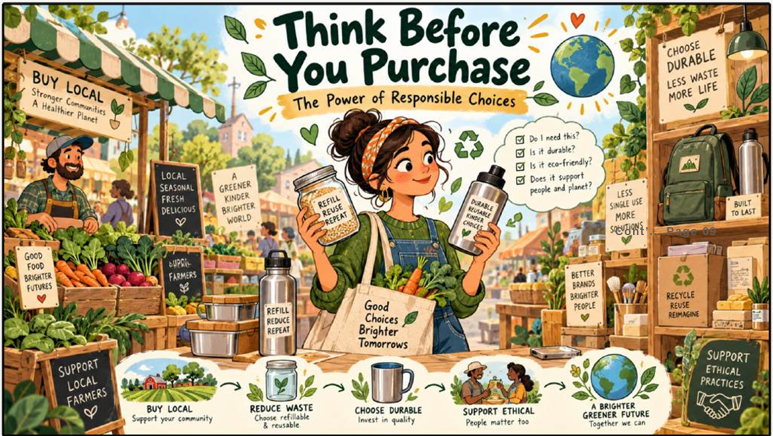
Every day, we make choices about what we buy, from food and clothing to household products and electronic equipment. While we often consider price, appearance, and convenience, our purchasing decisions can also have a significant impact on the environment. Responsible purchasing means thinking carefully before buying a product and considering its environmental and social impacts. By making better choices, we can reduce waste, conserve natural resources, and contribute to a healthier environment for future generations.
One of the first questions we should ask ourselves is, “Do I really need this product?” Many products are purchased on impulse and later become waste. Reducing unnecessary consumption is the most effective way to reduce waste generation. Before buying something, it is important to consider whether it is truly necessary or if an existing item can continue to be used.
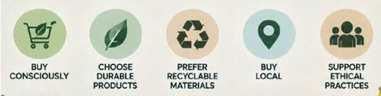
When purchasing a product, durability is an important factor to consider. Durable products last longer and do not need to be replaced frequently. Although a durable product may sometimes cost more initially, it often saves money in the long run and reduces waste generation. For example, a high quality reusable water bottle can be used for years instead of purchasing many single-use plastic bottles.
The materials used to manufacture a product also matter. Some materials have a lower environmental impact than others. Products made from recycled materials, natural materials, or sustainably sourced materials are generally better choices. On the other hand, products made from excessive materials that are difficult to recycle may contribute to environmental pollution.
Another important consideration is the origin of the product. Purchasing locally produced goods can help reduce transportation related emissions and support local businesses and communities. Locally produced products often require less packaging and travel shorter distances before reaching consumers. Responsible consumers should also think about the supply chain of a product. A supply chain includes all the stages involved in producing and delivering a product, from obtaining raw materials to manufacturing, packaging, transportation, and sale. Companies that follow ethical and environmentally responsible practices throughout their supply chains contribute to sustainability.
Recyclability is another important factor. Products that can be easily recycled help reduce the amount of waste sent to landfills. Before purchasing a product, it is useful to check whether its packaging or components can be recycled through existing waste management systems. Repairability is becoming increasingly important in a world where many products are discarded after minor damage. Products that can be easily repaired can remain in use for longer periods. Repairing an item is often cheaper and more environmentally friendly than replacing it with a new one.
Eco-design is another concept that supports responsible purchasing. Eco-designed products are developed with environmental considerations in mind. They often use fewer materials, generate less waste, consume less energy, and are easier to repair or recycle. Consumers can support sustainable production by choosing products that incorporate eco-design principles.
Making environmentally friendly purchasing decisions does not require perfection. It simply requires awareness and a willingness to think before buying. Every purchase sends a message to manufacturers about the type of products consumers value. When more people choose environmentally responsible products, businesses are encouraged to adopt more sustainable practices.
A purchase may take only a few seconds, but its environmental impact can last for years. This is where a proper, transparent, and credible eco-labelling scheme can play an important role. Eco-labels can help consumers quickly identify products that meet recognized environmental criteria, making it easier for environmentally conscious consumers to make responsible choices without having to investigate every product themselves. For an eco-label to be meaningful, however, it should consider the entire life cycle of a product, from the extraction of raw materials and manufacturing to transportation, use, and final disposal. A product may appear environmentally friendly at first glance, but its production, use, or disposal may still have significant environmental impacts. A life-cycle approach therefore helps ensure that eco-labels are based on a more complete and accurate assessment of environmental performance.
Our vision for the future is to establish a transparent, credible, and scientifically sound eco-labelling framework in Sri Lanka that provides consumers with clear and reliable information and makes responsible purchasing easier. Such a system can empower consumers to make better choices while encouraging businesses to improve the environmental performance of their products.
The next time you are about to make a purchase, pause before you pay. Choose quality over quantity, durability over disposability, and products that are better for people and the planet. Remember, every purchase is a choice, and every choice has an impact.
Author:

Dr. Nilanka Weerasinghe
Head, Cert Team,
TerraCert (Pvt) Ltd.
Membership No.: M00517